
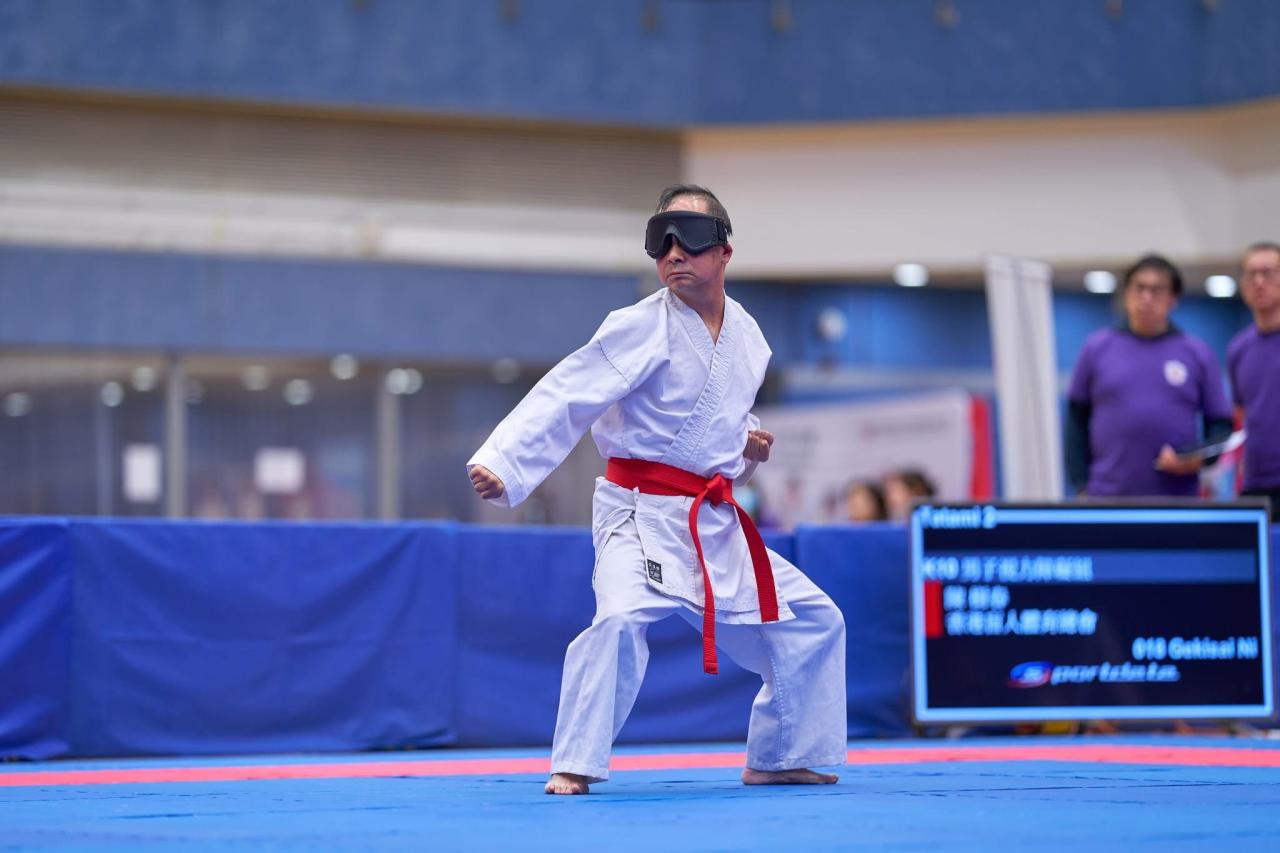
Para karate focuses on “kata” – a series of choreographed moves (not combat) – demonstrating strength, power, and speed while maintaining elements such as grace, rhythm, and balance.
Classification for events is divided into three categories: K10 for visual impairments, K21 for athletes with intellectual impairments, and K30 for athletes with an eligible physical impairment affecting their lower limbs. The WKF Para karate classification panel evaluates the required level of impairment for eligibility based on the Para karate Classification Rules.
The performance is evaluated from the bow starting the kata until the bow ending the kata.
Scores are given using a scale from 5.0 to 10.0 in increments of 0.1 (5.0 being the lowest possible score for a Kata that is accepted as performed and 10.0 represents a perfect performance). Disqualification is indicated by a score of 0.0
Athletes are evaluated on 10 criteria: stance, technique, transitional movements, timing and synchronisation, correct breathing, focus (KIME), conformance (consistence in the performance of the KIHON), strength, speed, and balance.
The system of elimination varies depending on the number of competitors. Generally, athletes are placed into brackets of eight and the number is reduced by four in each round until only two groups remain. The athletes with the highest score in each group compete against each other for gold with the runner up taking silver. The second highest scorer compete against the opposing group’s third highest scorer for the two bronze medals.
Para Karate is governed by World Karate Federation. The Karatedo Federation of Hong Kong, China Limited is the member of World Karate Federation in Hong Kong, China and the organization of elite development of Para Karate in Hong Kong, China.
Source of information credit: International Paralympic Committee
Source of photo credit: The Karatedo Federation of Hong Kong, China Limited